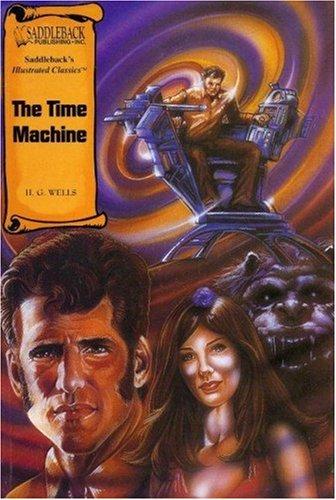
The Time Traveller, a dreamer obsessed with traveling through time, builds himself a time machine and, much to his surprise, travels over 800,000 years into the future. He lands in the year 802701: the world has been transformed by a society living in apparent harmony and bliss, but as the Traveler stays in the future he discovers a hidden barbaric and depraved subterranean class. Wells's transparent commentary on the capitalist society was an instant bestseller and launched the time-travel genre.
The Time Machine by HG Wells was first published in 1895 and I first read it in the 1990s some 100 years later. My memory was of the idea of treating time as a fourth dimension of equal standing to the three spatial dimensions. The distant future that Wells dreamed up did not linger in my mind when I came to re-read it.
It’s a simple story, told in the first person by the Time Traveller as he recounts it to his friends after returning from a trip to the year 802701. There is little detail of his machine, and only a brief argument in the opening scene as to how time travel might be plausible.
After leaving Victorian England, he landed in the same place, in a much changed, future world. He recounts his confusion and the process of making sense of his surroundings. First, he meets the pretty …
The Time Machine by HG Wells was first published in 1895 and I first read it in the 1990s some 100 years later. My memory was of the idea of treating time as a fourth dimension of equal standing to the three spatial dimensions. The distant future that Wells dreamed up did not linger in my mind when I came to re-read it.
It’s a simple story, told in the first person by the Time Traveller as he recounts it to his friends after returning from a trip to the year 802701. There is little detail of his machine, and only a brief argument in the opening scene as to how time travel might be plausible.
After leaving Victorian England, he landed in the same place, in a much changed, future world. He recounts his confusion and the process of making sense of his surroundings. First, he meets the pretty and delicate Eloi who don’t do much other than eat fruit, frolic and decorate their world with flowers. There is little evidence of an economy to support their carefree life. Later he encounters the agile, subterranean Morlocks who appear to take care of some kind of machinery below ground. Over time, the rather grisly truth of the relationship between the two races dawns on our traveller.
It becomes apparent that both are descended from humans and represent the eventual dichotomy between the upper and lower classes of the England he has travelled from. It’s hard to evaluate the plausibility or the effectiveness of this speculation on social matters from the perspective of the 21st century. The tale appears to assign much of the power in their relationship to the Morlocks, and little to the Eloi, which runs counter to how we know the future is turning out. Maybe it made more sense back then.
There are some insights into the state of technology and scientific knowledge at the end of the 19th century. The Time Traveller takes safety matches with him into the future, and knows how to make explosives. Knowledge of the life of stars is demonstrated in a brief (and rather pointless) detour to see the final days of our sun. Evolution takes a central role in the story. There are also hints at themes of human nature and the purpose of life which could be interesting, but are not well fleshed out.
This is a hero’s journey with a male protagonist overcoming challenges alone. He’s strong, brave and resourceful. Precisely two women are noticed in the book – one that crosses the room as the time machine begins it’s journey and one of the Eloi race whom our hero rescues and befriends. All of his friends listening to the story are men. While that might have been realistic back in 1895, it makes for a very alienating read in 2026.
All credit to Mr Wells for writing about time travel and the idea of a machine that would make it possible. However, re-reading this makes me even more convinced that the classics belong in history classes and do not deserve the prominence they get. As we grapple with complex scientific and social developments in the 21st century, we need to read more contemporary stories that can give us insights and frame our understandings of this world that we now inhabit. For me, the Time Machine has not stood up well to the passing of time.
Thought-provoking speculation about the future of humanity
5 stars
Content warning
Not sure why I'm putting a spoiler alert on a book that's more than a century old, but hey, you might not have seen either of the movies, and even if you did, they might not have made it clear what was going on with the Morlocks and Eloi.
I remember watching the 1960 movie of The Time Machine many times on TV when I was growing up. But somehow I never quite got around to reading the book until now.
It's a bit dry by modern standards, but the framing sequence does draw you in, and of course once he starts telling the story of his trip 800,000 years into the future, there's a wealth of speculation. The narrator self-conciously admits that he's drawing inferences on what's going on beyond what he sees, that the short week he had in that time isn't enough for him to be sure he really understands.
There's a bit of adventure, a bit of travelogue, a side trip to the last days of Earth before the expanding red giant sun swallows it up. But time travel isn't really the point. It's just the mechanism to comment on 19th century western society.
Eat the Rich:
The division between labor and capital, or working class and aristocracy, has become full-on speciation. Humanity has split into the beautiful, childlike, idle Eloi and the monstrous, brutal Morlocks who maintain the vast underground machines that provide the Eloi everything they need.
Ironically, the socialist Wells sets up his protagonist and his audience to have more in common with the Eloi than the Morlocks. The time traveler is upper class, has servants, and has the money and time to spend years tinkering with inventions. His friends gather for formal dinner parties, though they're mostly professionals rather than idlers. He pities the Eloi for their complete uselessness, identifies with them as they look more like today's humans, and of course has nothing to fear from them. The Morlocks look more monstrous to him, and you get the impression that even if they weren't attacking the Eloi at night and stealing the time machine, he'd still be horrified rather than pity their fate.
(Interesting side note: the description of the Morlocks in the book is awfully similar to the way Weta Digital designed Gollum. And yet Bilbo and Frodo both found it in their hearts to pity him.)
It's a cautionary tale of what happens when you treat whole classes as subhuman, and still insist that they do all the work for you.